
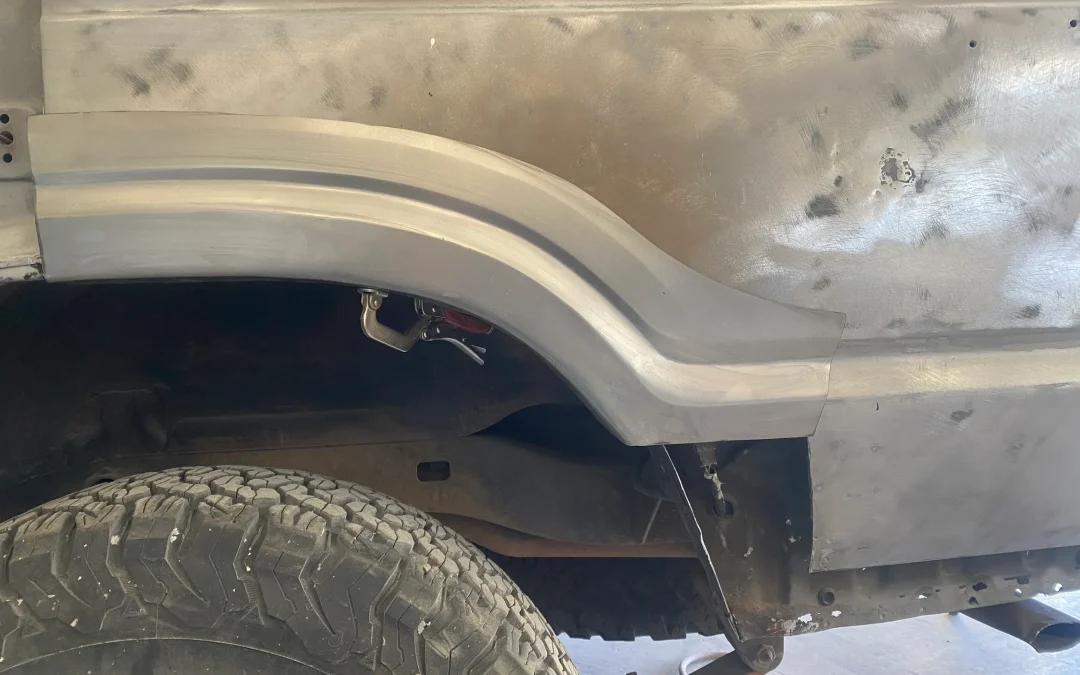
Structural rust affects load-bearing parts of a classic vehicle — frame rails, floor supports, rocker structures, pillars, and body seams. Cosmetic rust affects appearance only — surface oxidation, light pitting, rust under chipped paint. The difference matters because structural rust is a safety issue and a repair-or-replace decision, while cosmetic rust is a maintenance item that can be addressed at the surface.
The mistake most owners make is assuming that what they can see is all there is. On a 50-year-old vehicle, the rust visible from the outside almost always represents 20–40% of the actual corrosion. The rest is hiding in seams, behind brackets, and inside cavities you can’t inspect without disassembly.
Table of Contents
Quick comparison: structural rust vs cosmetic rust
| Structural rust | Cosmetic rust | |
|---|---|---|
| Where it lives | Frame rails, floor supports, rockers, pillars, cab mounts, body seams | Outer panel surfaces, door edges, fender lips, paint chips |
| What it affects | Strength, rigidity, safety, alignment | Appearance only |
| How to find it | Disassembly, stripping, bare-metal inspection | Visible from the outside |
| Repair approach | Cut out rusted metal, fabricate or weld in replacement, restore structure | Strip, treat, prime, refinish |
| Typical labor | 20–600+ hours per area | 2–10 hours per spot |
| Cost range | $2,600 – $78,000+ | $260 – $1,300 |
| Safety risk | Real and progressive | None until it spreads to structure |
| Can be deferred | Never | Short term, yes |
| Reversible by paint? | No | Sometimes — if caught early |
For the full breakdown of what each type of repair costs, see our classic car rust repair cost guide.
What is structural rust?
Structural rust is corrosion that affects parts of the vehicle responsible for strength, rigidity, alignment, or load-bearing support. On a classic, it shows up in predictable places: rocker panels and inner rocker structures, floor pans where they meet the rocker, cab mounts, frame rails, A-pillars and B-pillars, the cowl, and the seams where major panels tie together.
Here’s what it looks like in real work:
Rocker panels are the most common structural rust we see on classic vehicles. On a 1970s Land Cruiser, the inner rocker is a hollow box section that traps moisture from the wheel well side. By the time the outer rocker shows bubbling paint, the inner rocker is usually 60–80% gone — and the inner rocker is what holds the body’s side rigidity. There’s no patch for what isn’t there. We fabricate a new inner rocker from raw steel, weld it in, then address the outer skin. That’s a 30–60 hour job per side, and it’s structural the whole way through.
FJ55 cowls are a textbook structural rust example. The cowl sits between the windshield and the firewall and collects water through the vents above. By the time you can see rust at the cowl seam, the inner cowl panel is usually rotted across most of its width and rust has migrated into the firewall and the A-pillar bases. We’ve never opened a rusted FJ55 cowl and found that the visible rust was the whole story.
Floor pans become structural the moment the rust crosses into the floor-to-rocker junction. A rusted-through center floor section is a body repair. A rusted floor that’s eaten into the rocker mount or the cab mount is structural — that’s a load-bearing connection point and the body won’t sit straight if it fails. The line between “floor repair” and “structural repair” is invisible until you strip the underside and look.
When these areas lose metal thickness, the vehicle’s structural integrity is compromised even if the exterior still looks acceptable. The body flexes more under load, panels start to misalign, doors stop closing right, and crash protection drops. Corrosion doesn’t pause — it progresses as moisture and oxygen interact with steel, gradually reducing thickness and strength. The American Society for Materials Performance and Protection covers the materials science of how this happens.
[PHOTO: Inner rocker structure cut out of an FJ55 or FJ40, showing how much metal was missing behind the outer skin. Caption: “Inner rocker on a 60 Series Land Cruiser. From the curb, the outer rocker looked marginal. After cutting it out, we found the inner box section was 70% gone.”]
What is cosmetic rust?
Cosmetic rust is corrosion limited to non-structural surfaces. It includes surface oxidation on exterior panels, light rust under chipped paint, shallow pitting that hasn’t reduced panel thickness, and rust bleeding from a stone chip on the hood or fender.
The defining feature is that the metal underneath is still sound. You can strip it, treat it, prime it, and refinish it without rebuilding anything. The repair takes hours, not days.
A typical cosmetic rust job on a classic looks like this: a 1972 C10 with a quarter-sized rust spot on the lower fender from a paint chip that wasn’t sealed. The spot is bleeding a little, the paint around it is lifting, and there’s a soft halo of surface oxidation. Five hours of work — strip the area to bare metal, treat the rust with phosphoric acid, prime with epoxy, sand, refinish, blend the paint. Done.
The risk on cosmetic rust isn’t the rust itself. It’s that what looks cosmetic from the outside often isn’t. We’ve stripped “small surface spots” on quarter panels and found penetrating rust on the back side that turned a 5-hour job into a 40-hour job. This is why we don’t quote cosmetic rust as a fixed price without inspection — and why no honest shop will.
[PHOTO: A genuinely cosmetic rust spot on a fender or door edge before repair. Caption: “Cosmetic rust on a fender edge. Surface oxidation only — the metal underneath is sound. This is a five-hour job done right.”]
Why the difference matters
The repair approach is completely different. Cosmetic rust is body work. Structural rust is engineering work. A good body shop can handle cosmetic rust on a classic. Structural rust requires a shop that knows how to fabricate, weld structural sections, and judge what can be saved versus what has to be replaced from raw steel.
Treating structural rust as cosmetic is one of the most common reasons restorations fail. Someone buys a classic that’s been “restored,” drives it for a year, and the rust starts showing up through the paint. What happened: the previous shop ground off the visible rust, filled it with body filler, and painted over the top. Underneath the filler, the structural rust is still there. It’s still active. It eats outward until it breaks through the new paint, and the customer is back where they started — except now the filler has to come out before the actual repair can begin.
The cost difference is also enormous. A cosmetic rust spot is a few hundred dollars. A structural rocker rebuild is several thousand. A body-off restoration where every seam is opened and addressed at bare metal can run into the tens of thousands. The full breakdown is in our classic car rust repair cost guide, but the headline is that the difference between a cosmetic estimate and a structural reality can be 10–50x.
Is structural rust dangerous?
Yes. Structural rust can make a vehicle unsafe in several specific ways:
- Reduced crash protection. The vehicle’s body and frame are designed to absorb and distribute impact energy. Rust-thinned metal absorbs less and fails earlier.
- Body flex and misalignment. A compromised rocker or floor structure lets the body twist under load. Doors stop closing right, panel gaps shift, and the vehicle handles differently.
- Weakened mounting points. Seat belts, seats, doors, and suspension components all bolt to the body. Rust at the mount point means the bolt has nothing to hold to.
- Compromised suspension and chassis connections. Frame rust at a control arm mount or a leaf spring hanger isn’t theoretical — it’s the part of the truck that keeps the wheels attached.
When rust affects structural components, it stops being a cosmetic concern and becomes a safety issue. This is the part owners sometimes don’t want to hear, especially when the vehicle “looks fine” and “drives fine.” The vehicle drives fine until the day it doesn’t, and the day it doesn’t is usually a sudden one.
Is cosmetic rust serious?
Cosmetic rust isn’t immediately dangerous, but it should not be ignored. Left untreated, cosmetic rust will:
- Spread beneath paint as moisture wicks under the lifted edges
- Migrate into seams and folds where it transitions from cosmetic to structural
- Eventually become structural over time, especially in vehicles stored or driven in humid environments
The good news: cosmetic rust is manageable when you catch it early. A $500 cosmetic repair today prevents a $5,000 structural repair in three years. The math is hard to argue with.
How to tell if rust is structural
Accurate diagnosis on a classic requires more than a visual inspection. From the outside, structural and cosmetic rust often look identical. The signs that rust is structural and not cosmetic:
- It appears at seams, folds, or spot welds. Rust at a seam means corrosion is active on both sides of the joint and likely deep inside it.
- The metal flexes or sounds dead when tapped. Sound metal rings. Rust-thinned metal thuds.
- Stripping reveals reduced thickness. Sound metal feels solid under a wire wheel. Rust-thinned metal grinds away easily.
- Corrosion extends into internal cavities. Visible rust at the bottom of a rocker drain hole means the inside of the rocker is worse.
- Panels lose rigidity once rust is removed. If cutting out a rust spot leaves the surrounding area floppy, it was structural.
This is why we do bare-metal inspection on every restoration project. There is no other reliable way to know what’s actually there. Anyone telling you they can give you a definitive structural assessment from photos or a walk-around is guessing.
[VIDEO EMBED: Kelly’s FJ55 cowl removal video or similar — paste the URL on its own line and WordPress will auto-embed.]
Can structural rust be repaired?
Sometimes — but not always. Structural rust can be repaired only when:
- Sufficient sound metal remains around the affected area to weld to
- Strength can be fully restored through the repair
- Corrosion hasn’t spread through multiple layers in ways that compromise the geometry
Once metal loss reaches a certain point, repair alone is no longer viable and fabrication becomes necessary. We cover when structural rust can still be repaired and when panels must be fabricated from raw steel in separate articles.
The decision framework, simplified:
- If reproduction parts exist for your vehicle, structural rust is usually repairable by cutting out the rusted section and welding in the reproduction panel. Mustangs, Camaros, popular trucks fall here.
- If reproduction parts don’t exist, the section has to be fabricated by hand from raw steel. Land Cruisers, vintage VWs, less popular marques fall here. The repair is still possible — it just takes more hours.
- If the rusted area is too large or too geometrically complex to fabricate as a single piece, the repair becomes a multi-stage rebuild and the cost climbs into restoration territory.
- If multiple structural areas are simultaneously compromised, the vehicle may need a body-off approach where the body comes off the frame and every section is addressed at bare metal.
Structural rust repair on a classic typically runs 250–600+ hours of labor for a moderate-to-heavy job. See our full cost breakdown for the math at the current shop rate.
Can cosmetic rust be repaired?
Yes, when:
- Rust is limited to surface oxidation
- Metal thickness remains intact
- Corrosion hasn’t entered seams or folds
Cosmetic rust repair focuses on stopping oxidation before it spreads, not rebuilding structure. The process: strip the area to bare metal, treat with phosphoric acid or mechanical abrasion to neutralize remaining oxidation, prime with epoxy, refinish, blend the paint into the surrounding panel.
The whole job is hours, not days. But — and this is the warning — the inspection during stripping is non-negotiable. If stripping reveals that the rust extends past the visible boundary or has eaten through to the back side, the job stops being cosmetic and the price goes up.
When rust makes a car unsafe
Rust makes a classic unsafe when it affects:
- Structural attachment points — anywhere a load-bearing part bolts to the body or frame
- Occupant protection areas — pillars, roof structure, door beams, seat mounts, belt mounts
- Load-bearing body components — rockers, floor pans where they meet the rocker, cab mounts, frame rails
Floor pan rust becomes structural when it compromises supports. Body rust becomes structural when it affects rigidity — even on body-on-frame vehicles, where people sometimes assume the frame does all the work. It doesn’t. The body provides torsional rigidity that the frame alone can’t, and a rusted body on a sound frame still flexes more than it should.
If you’re driving a classic with visible rust at any structural location, get it inspected. The cost of inspection is small. The cost of finding out the hard way is not.
Body rust vs frame rust
Both matter, but they affect different systems.
Body rust affects the cab, the floor, the rockers, the pillars, the panels. It impacts alignment, rigidity, panel fit, and the safety structures designed to protect occupants in a crash.
Frame rust affects the chassis itself — the rails, the crossmembers, the suspension mounting points. It impacts the load-bearing skeleton the body and drivetrain bolt to.
A solid frame doesn’t compensate for a compromised body, and a solid body doesn’t compensate for a compromised frame. Both have to be addressed separately, and the worse of the two usually determines the scope of the project.
The most common mistake we see: someone buys a classic with visible body rust and assumes the frame is fine because they can’t see anything. Then disassembly reveals the frame rails are perforated where debris collected against them for 40 years. The body work and the frame work are separate jobs. We do the body work only; the frame has to go to a frame shop.
Frequently asked questions
How do professionals evaluate rust in classic vehicles?
Rust evaluation requires inspection of seams, structural joints, and internal cavities — usually with partial or full disassembly. Visual inspection from the outside cannot determine the extent of corrosion or whether metal integrity has been compromised. A proper evaluation means the vehicle is up on a lift, the interior is out, the carpet is out, the trim is off, and the affected areas are stripped to bare metal so the actual condition of the steel is visible.
Is all rust on a classic car a serious problem?
No. Some rust is cosmetic and affects appearance only. Other rust is structural and impacts strength, rigidity, or safety. The significance depends on where the rust is located and how much metal loss has occurred — not how visible it is from the outside. A small structural rust spot at a critical joint matters more than a large cosmetic spot on a flat panel.
Can rust always be repaired, or does it sometimes require fabrication?
Rust can be repaired only when sufficient sound metal remains. When corrosion has reduced metal thickness, spread through seams, or affected structural areas, fabrication or full replacement is required to restore integrity. This is more common on vehicles where reproduction panels don’t exist — the only option is to make the part from raw steel.
Why does rust often return after repairs?
Rust returns when the corrosion isn’t fully removed at the metal level. Surface repairs hide oxidation inside seams or cavities, and that oxidation continues to grow under the new paint or filler. Within 1–3 years, it works its way back to the surface and the customer thinks the shop did bad work. The work was bad — but the failure mode is predictable.
How can I tell if my classic has hidden rust?
Hidden rust shows up as bubbling paint, swelling at seams, soft metal that flexes when pressed, misaligned panels, doors that don’t close right, and rust bleed from drain holes. None of these are conclusive on their own. The only reliable way to know what’s hiding inside the body is to strip and disassemble.
Does rust affect safety in classic vehicles?
Yes, when it compromises structural components — rockers, floors, pillars, mounting points. Structural rust reduces crash protection, body rigidity, and the integrity of seat belt and seat mounting points. A classic with structural rust at the wrong location is not safe to drive, even if it appears solid from the curb.
Why is documentation important during restoration?
Documentation lets owners see corrosion as it’s uncovered, understand why specific repairs are necessary, and verify that the work was done at the metal level rather than over the top. Hidden rust can’t be evaluated accurately without visual records, and restoration decisions should be made with full information, not based on what was guessed before disassembly. We document every project with before, during, and after photos.
Does this apply to all classic cars?
Yes. Designs differ between marques, but corrosion patterns and failure points are consistent across classic vehicles because the underlying materials, construction methods, and exposure to moisture are similar. A 1970 Land Cruiser, a 1967 Mustang, and a 1972 C10 all rust in different specific places — but the structural-vs-cosmetic distinction applies to all of them in the same way.
The decision framework
Structural rust is not defined by how bad it looks. It’s defined by what it affects.
When you’re trying to decide what to do with a classic that has rust, the questions are:
- Is the rust at a load-bearing location? If yes, it’s structural until proven otherwise.
- How much sound metal is left around it? This determines whether repair is viable or fabrication is required.
- Is the vehicle worth what the structural repair will cost? For investment-grade classics and sentimental vehicles, almost always yes. For middle-tier classics, the math gets closer.
- Has the rust been touched before? Previous cosmetic “repairs” over structural rust make the current job more expensive because the filler and paint have to come off before the real work can start.
If you need help working through this on a specific vehicle, that’s what we do for a living. Send us photos of the rusted areas — every panel, every seam, the floor from underneath, the rockers, the frame rails — and we’ll give you a realistic range of what’s likely to be required.
Email: info@restorationsector.com Phone: (928) 476-0250 Location: Cottonwood, AZ — vehicles shipped in from out of state by appointment.
For the cost side of this conversation, see our full classic car rust repair cost guide.

About the Author: Kelly Saad
Kelly Saad is the owner of Restoration Sector and has over 35 years of hands-on experience restoring classic vehicles. His work focuses exclusively on body restoration — structural rust repair, metal fabrication, and restoration-level paint preparation. Restoration Sector only paints vehicles restored in-house, ensuring long-term finish stability.

Serious Restoration Starts at the Metal
Restoration Sector specializes exclusively in body restoration for classic vehicles — addressing rust, structural metal repair, fabrication, and restoration-level paint at the bare-metal level.
Vehicles are only painted after full in-house restoration work, ensuring finishes remain stable, durable, and true to the underlying structure.
Serving Arizona and nationwide clients via vehicle transport

